The Han River does not feel like a boundary. It feels like a pause. Water widens across Seoul in long, quiet stretches, then narrows again beneath bridges that seem to hover rather than interrupt. Apartment towers stand back from the edge. Hills appear faint in the distance, more suggestion than backdrop.
Wind moves differently near the river. It carries fragments of sound — laughter, a bicycle chain clicking, a distant announcement — and then releases them. The skyline does not press forward. It settles into the horizon.
You walk without aiming anywhere specific. The river continues regardless.
Where the Surface Holds Its Line
The Han’s current is not dramatic. It shifts slowly, reflecting sky in muted bands that change with cloud rather than clock. Concrete steps descend toward water, worn but not eroded. The movement feels steady, unremarkable in the best sense.
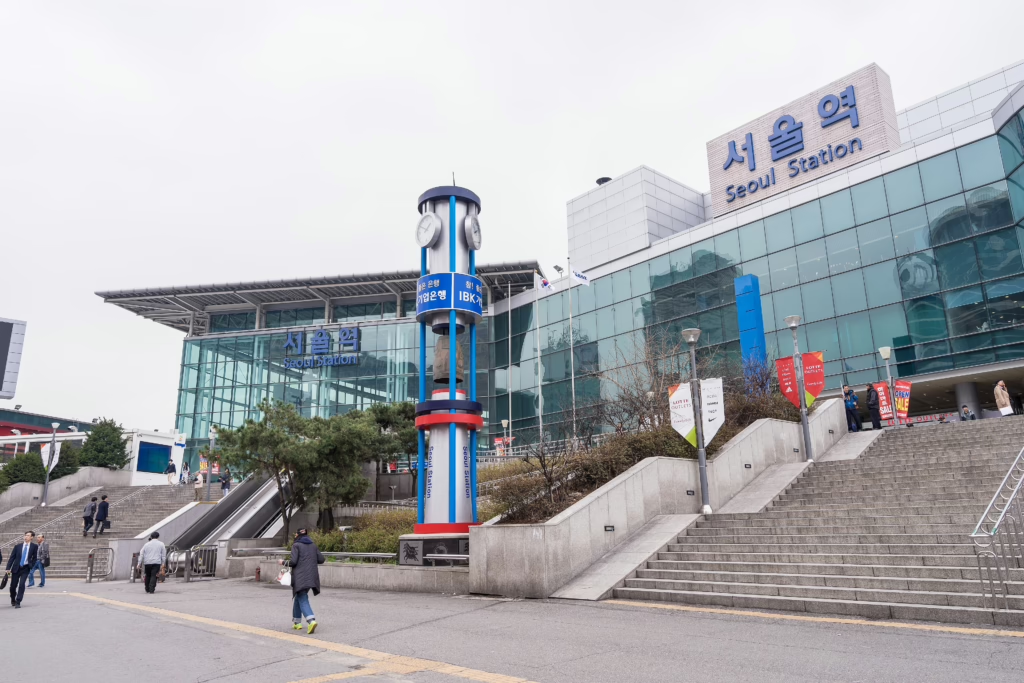
Later, the corridor south unfolds in similar increments along the train ticket from Seoul to Busan, where fields appear between apartment clusters and then dissolve into low hills. The adjustment feels procedural, almost neutral. One landscape yields to another without declaration.
Inside the carriage, reflection doubles everything — passenger silhouettes hovering over rice paddies, overhead lights faintly suspended above farmland. Speed registers, but gently.
Sound That Refuses to Condense
Busan gathers energy differently. At Jagalchi Market, the harbour air carries salt and something metallic. Vendors speak in overlapping tones that never quite merge. Crates shift. Water drains from freshly rinsed fish and slips toward the edge of the dock.
The route described as Seoul to Busan by train does not prepare you for the market, nor does it contrast it sharply. The transition feels less like arrival and more like compression — open fields tightening into port, skyline lowering toward sea.
At Jagalchi, nothing escalates. The bustle sustains itself at one level. Boats rock faintly against the quay. Light reflects in fragments across wet pavement.

Between Current and Dock
The Han stretches horizontally, holding distance between its banks. Jagalchi feels closer to the ground, closer to hands and voices. Yet both operate in repetition — bridge after bridge, stall after stall, ripple after ripple.
Neither space insists on being interpreted. The river does not symbolise calm. The market does not represent intensity. They continue on their own terms.
The cadence remains even.
The Corridor That Does Not Announce Itself
Later, memory rearranges river and harbour into similar surfaces — water moving beneath concrete, water moving beneath hull. The rail journey thins into background hum, a steady line that feels less like distance travelled and more like continuity maintained.
You remember wind more than skyline. You remember the way sound thinned near the Han and layered near the docks. The differences soften over time.
And somewhere between bridge shadow and fish crate, between slow current and tidal edge, the movement persists quietly — not resolved into capital or coast — simply unfolding along a peninsula where water remains present, even when it shifts form.
Where Light Lingers on Water
There are hours when the river and the harbour seem to share the same muted sheen. In Seoul, late afternoon stretches thin across the Han, turning the surface almost metallic before fading into grey. In Busan, that same light catches along the edges of boats and puddles on the market floor, then slips away without announcement. The change feels gradual enough to go unnoticed until everything has shifted tone.
Neither place grows dramatic at dusk. The river does not flare into colour. The market does not dim into silence. Both hold their pace as brightness thins.
The Line That Remains After Departure
Between north and south runs a corridor of track that resists emphasis — stations appearing briefly, hills gathering and dissolving, apartment blocks aligning against horizon. The rhythm beneath the floor becomes more memorable than any single view.
Later, the distinction between riverbank and dock loosens further. Water moving under bridge and water moving under hull align in recollection. Voices and wind become variations of the same low register. And somewhere along that steady span, the motion continues quietly, carried forward without ceremony, without conclusion.