The back-to-school countdown is on. And while parents are busy buying uniforms, labelling clothes and choosing lunchboxes, for young children they might have more troubling things on their minds.
To help calm first-day nerves and turn the first day at school into a positive experience, leading kids’ yoghurt brand*, The Collective has teamed up with Dr Amanda Gummer, a research psychologist who specialises in child development and play, to launch The Big School Letter Swap – to celebrate the excitement, nerves and big feelings that come for youngsters when they start or head back to school .
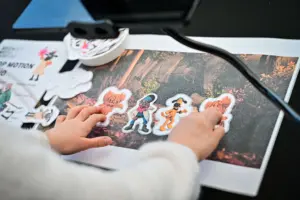
The Big School Letter Swap will encourage children to draw a picture or write a short note telling The Collective’s Yog Squad what they’re looking forward to or wondering about. In return, they’ll receive a personalised reply packed with child-friendly reassurance and encouragement.
To support this initiative, new research** from The Collective also shows that combined with all the positives that a new school can bring, young children are also experiencing a range of social and emotional concerns as they prepare to start or return to school,
The research reveals the biggest concerns for children starting school are:
| Making Friends | 19.3% |
| Getting to know their new teacher | 17.3% |
| Not fitting in or being liked | 17.1% |
| How hard the lessons will be | 16.5% |
| Being away from their parent or guardian | 9.5% |
| Having less free time | 9.3% |
| Not liking the food | 5.8% |
| Going to the toilet alone at school | 3.2% |
| Wearing school uniform | 2.2% |
Commenting on The Big School Letter Swap initiative, Dr Amanda Gummer said: ‘“Children do not need to be talked out of their worries. They need to be believed and then given something small they can actually do to help”
The Big School Letter Swap is open to children aged 4-8 who are UK residents/UK only
Find out more from 24th August, by visiting: thecollectivedairy.com/yogsquad/letterswap
Further information: Parenting Tips from Dr Amanda Gummer
Dr Gummer and The Collective have also created a series of tips to help parents prepare both their children, and themselves, ahead of the new term starting. Dr Gummer’s advice focuses on reframing each worry and then offering practical advice on how to tackle it.
Making Friends:
Children this age do not make friends by talking. They make friends by doing. Friendship at four, five and six is built shoulder to shoulder, over a shared activity, not face to face over a conversation. So the goal is not to teach a child how to be likeable. It is to get them into a game. Work with them to develop an opener like ‘Do you want to play?’ until it comes out automatically. Make sure your child is aiming for someone to play with ‘that day’, not a best friend – these take time to make and you need to make sure they don’t feel pressure to find one quickly.
Getting to know their new teacher
What children are frightened of is not the teacher. It is the unknown. The job here is to turn a role into a person, and to do it before day one. Give your child one concrete fact. A name, the colour of the classroom door, whether the teacher has a dog. One detail is enough to turn a stranger into someone familiar and frame the teacher as a helper with a job. “Their job is to look after you and help you learn.” Children this age respond well to clear roles.
Not fitting in or being liked
This sounds like the friendship worry but it is not. Making friends is about skills. Fitting in is about belonging, and belonging is built at home first. Children who feel secure at home take more social risks at school. Name the feeling, then normalise it. For example “You are worried they will not like you. I remember feeling like that, lots of children do. It usually settles in the first week so let’s plan something fun for the weekend and see how you’re feeling then.” Give them something to bring. A game they know, a shared interest, a joke. Children connect over things, and shared activities.
How hard the lessons will be
The worry underneath this is not difficulty. It is getting things wrong in front of other people. So ,the answer is not to promise that school will be easy. It is to change what counts as doing well. Praise the effort and the strategy, not the outcome. “You kept going when it got tricky” is far more useful than “you are so clever”. Let them see you get something wrong. Model it, laugh, carry on. This takes about ten seconds and it is one of the most powerful things a parent can do. Adding the word “yet”, from “I cannot do it” to “I cannot do it yet”. This is a tiny change that measurably shifts how children approach difficulty.
Being away from their parent or guardian
Separation anxiety is not a sign that something has gone wrong. It is a sign of a secure attachment, and it is developmentally normal at this age. But long goodbyes make it worse, not better. Keep goodbyes short, warm and identical every single day. A hug, the same phrase, and go. Predictability settles children. Extra time does not. Give them the reunion, not the absence. “I will be back after story time” is much easier for a child to hold on to than “I will miss you”.
Having less free time
This one is a real loss and children are right to notice it. Do not talk them out of it. Protect the time instead. Free play is not what children do when the important things are finished. It is how they process everything else. Guard one unstructured hour a day if you possibly can. Nothing fancy, just time with nothing scheduled in it.
Not liking the food
Lunchtime worry is rarely about taste. It is about unfamiliar surroundings, noise, and a time limit. Solve the logistics and the food worry usually shrinks with it. Practise the mechanics at home. Opening the packaging, carrying a tray, finishing within a set time. That is usually the actual sticking point. Look at the menu together and pick one safe option for each day. Having chosen in advance reduces the anxiety considerably.
Going to the toilet alone at school
Only 3.2% of parents put this top, but for the child who has this worry it colours the entire day. Small in the ranking, large in the child. Practise the practical steps. Buttons, taps, locks, hand dryers. Confidence here is built in the details but do it playfully and make it fun. Teach the sentence and rehearse it. “Can I go to the toilet please?” Say it until asking feels like nothing. Choose uniform they can manage on their own. Elastic waists, big buttons or Velcro. Independence beats smartness in September and make sure they know accidents happen and that staff deal with them all the time. Taking the shame out of it is the single most useful thing you can do.
Wearing school uniform
Bottom of the list, but uniform is often the first thing that makes school feel real to a child. That makes it a useful tool rather than a problem. Wear it before term starts. Around the house, in the garden, to the park. Familiarity does almost all of the work and it’s a great opportunity to role play ‘school’. Let them practise dressing themselves in it, slowly, with no one waiting. Independence matters more than speed. Take sensory complaints seriously. Labels, seams, stiff collars. If a child says it is itchy, they mean it, and it will distract them all day.