A giant new tapestry created with the help of children has gone on display in London, charting the history of how we have paid for things – and imagining how families could be shopping in the future.
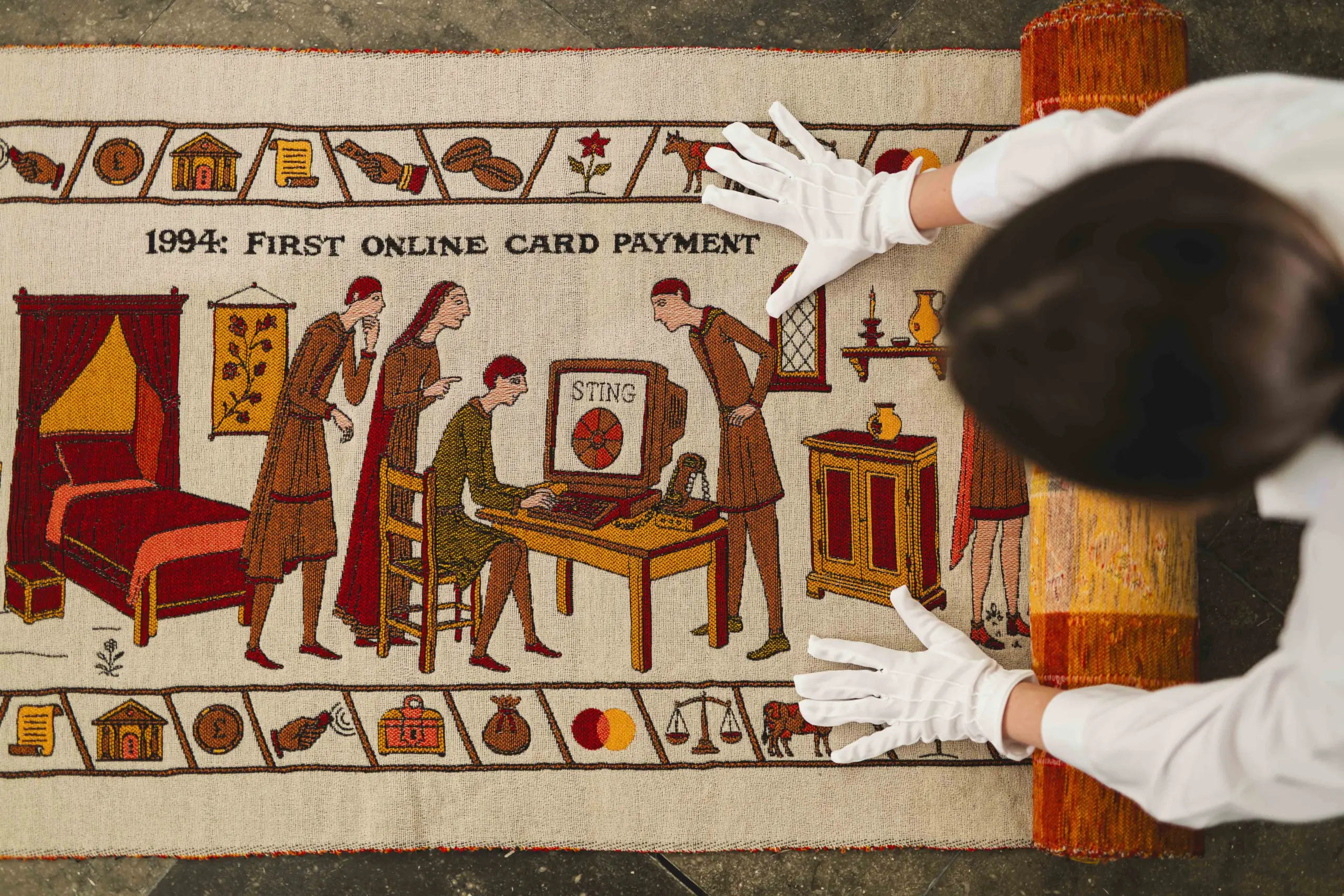
As the original Bayeux Tapestry returns to England for the first time in almost 1,000 years, Mastercard has unveiled its own 10-metre-long tapestry.
Called the ‘Payeux Tapestry’, the colourful artwork tells the story of payments and shopping through 15 scenes, beginning with cowrie shells used around 1200 BCE and ending with a futuristic vision of AI-powered shopping and robots.
And children have played a starring role in creating it.
Children Help Bring The Payment Story To Life
Fifteen children were invited to draw scenes showing different moments in the history of money and shopping.
Their artwork was then transformed into a giant woven tapestry under the direction of Mia Hansson, who has spent almost a decade hand-embroidering her own full-size, 70-metre replica of the Bayeux Tapestry.
The project took:
- 200 hours to create
- Five weavers
- One illustrator
- 15 children
- 19 colours
- 34,800 passes of a jacquard loom
- Wool and cotton
- A TC2 jacquard loom
The finished artwork stretches for 10 metres.
The first 10 scenes look back at how the way we pay has changed over thousands of years.
Cowrie shells and coins are followed by paper money and handwritten cheques before moving into the modern era of credit cards, contactless payments and mobile wallets.
Three of the children involved were from the UK.
Anvitha Kumar drew the first modern credit card from the 1950s, while Hanna Lengyel illustrated Mastercard’s real-life 2025 agentic payment milestone with Worldline and ING.
Meanwhile, Liliana Mansouri looked much further into the future, imagining a world where home robots do the shopping and make payments within limits set by their owners.
What Could Shopping Look Like In 2030?
The final five scenes of the Payeux Tapestry move away from history and into the future.
Mastercard worked with four futurists to imagine how shopping and payments could change by 2030.
Some of the predictions sound like they have come straight from a science-fiction film.
The tapestry imagines:
- Personal AI shopping assistants buying everyday items
- AI arranging and booking holidays
- Smart fridges ordering groceries when supplies run low
- AI agents negotiating prices
- Technology helping people stick to their budgets and diets
- Robots carrying out the weekly shop
- Robots combining online ordering with physical collection
According to Mastercard’s accompanying report, one in 10 consumers could be using a trusted AI assistant to shop and pay on their behalf by 2030.
The idea is that people could hand over some of the more routine shopping decisions – such as buying groceries, toiletries and subscriptions – while keeping control over what their AI assistant is allowed to purchase.
Could AI Do The Weekly Shop For Us?
The concept is known as ‘agentic commerce’, where AI doesn’t simply recommend something for you to buy but can actually help carry out the transaction.
Mastercard says Europe has already taken a step towards this future, following what it describes as Europe’s first end-to-end agentic payment earlier this year.
The transaction involved an AI agent initiating a purchase, with the shopper approving it.
Futurist Magnus Lindkvist predicts that taking care of routine transactions could ultimately leave shopping as something people choose to do for “discovery, inspiration and pleasure.”
A Tapestry Looking To The Future
Creative director Mia Hansson said the artwork was designed to show just how dramatically the way we pay has changed.
“Tapestries have historically been used to tell our biggest stories, one stitch at a time.”
She explained that while the original Bayeux Tapestry tells a story ending in death, the Payeux Tapestry finishes by imagining something completely new.
“Mastercard’s version ends with a new birth, imagining a way of shopping and paying that nobody has experienced yet.”
She hopes the artwork will encourage people to think about how quickly technology is changing the world of finance.
“Laid out in thread, scene by scene, you realise how far we’ve come, and the exciting times to come.”
Simon Forbes, President of Mastercard UK & Ireland, said:
“AI increasingly helps people decide what to buy; tomorrow it will help do the purchasing for them too.”
He added that Mastercard’s technology is focused on making these transactions secure while ensuring consumers remain in control.
From Cowrie Shells To AI Shopping Assistants
The Payeux Tapestry offers a fascinating snapshot of how dramatically shopping has changed.
Thousands of years ago, people used objects such as shells as a form of payment. Today, many of us rarely carry cash and can pay for something with a tap of a card, phone or smartwatch.
And if Mastercard’s predictions become reality, the next generation could grow up in a world where AI assistants and robots take care of some of the everyday shopping for them.
The artwork has been unveiled to coincide with the return of the original Bayeux Tapestry to the British Museum, giving families another unusual way to think about the past – and what the future might look like.