A new national campaign launches today (1 June 2026) during Child Safety Week to help improve protection for child passengers and support the Government’s ambition to reduce child road deaths and serious injuries by 70% by 2035.
Rear Face for Safety is calling for a change in how child car seat safety is communicated across the UK, encouraging parents to keep children rear-facing until at least four years of age. The campaign is backed by evidence showing children are up to five times safer travelling rear-facing than forward-facing.
In a frontal collision, rear-facing seats provide enhanced protection for a child’s head, neck and spine by distributing crash forces across the back of the child restraint rather than concentrating them on vulnerable areas of the body.
Launched during Child Safety Week (1–7 June), the campaign recognises child passenger safety as a shared responsibility and advocates for clear, consistent messaging throughout the parenting journey. Its goal is to ensure parents understand that rear-facing travel offers greater protection and is recommended well beyond the current legal minimum requirements.
The initiative calls for healthcare professionals, public health teams, retailers, maternity and early years services, and local and national government to provide parents with clear, evidence-based advice on child passenger safety.
Rear Face for Safety brings together independent supporters from across road safety, academia, policing, transport, child injury prevention and consumer organisations, alongside leading Swedish child road safety experts. The initiative is led by Axkid.
Supporters include transport safety experts and academics, as well as organisations such as the Child Accident Prevention Trust (CAPT), Royal Society for the Prevention of Accidents (RoSPA), Road Safety Foundation, Road Safety GB, Parliamentary Advisory Council for Transport Safety (PACTS), Police Scotland, Scottish Fire and Rescue Service, Confused.com, MPs, Police and Crime Commissioners, The AA Charitable Trust and IAM RoadSmart.
The campaign is also backed by Swedish organisations Folksam, Chalmers Industriteknik and NTF Sweden, all of which have contributed to Sweden’s internationally recognised Vision Zero approach to road safety. Their work has helped Sweden achieve one of the lowest child road casualty rates in the world.
In 2024, 22 children were killed and 537 seriously injured while travelling as car occupants on UK roads. During the same period, 42% of car occupants under the age of 16 who died in collisions were not using a seatbelt or appropriate child restraint.*
Earlier this year, the Government published a new Road Safety Strategy with ambitious casualty reduction targets, including a 65% reduction in road deaths and serious injuries overall and a 70% reduction among children under 16 by 2035.
Rear-facing travel represents one evidence-based measure within the wider programme of action needed to help achieve these goals.
A Family’s Story
The campaign is being supported by Jenny Everson, whose son Marlo was protected by a rear-facing car seat during a serious collision.
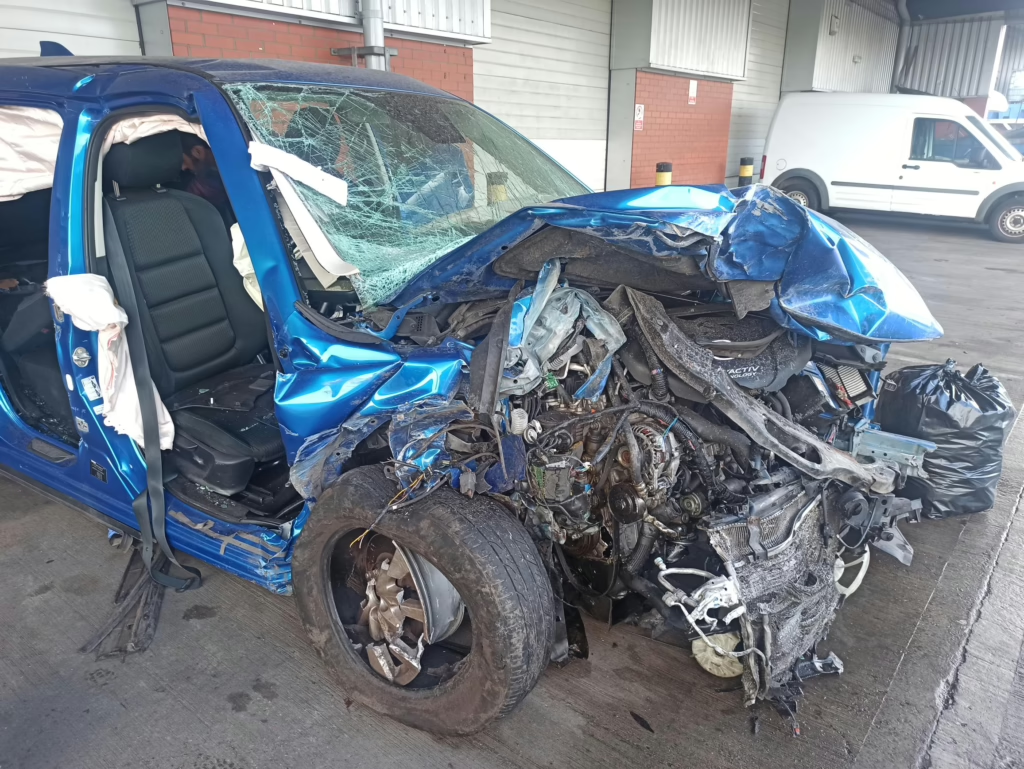
In December 2023, Jenny was driving on Sheffield Parkway when a speeding driver crossed through a gap in the central reservation and collided head-on with her vehicle. Jenny and her mother, who was travelling in the front passenger seat, were both knocked unconscious and suffered serious injuries requiring hospital treatment and extensive rehabilitation.
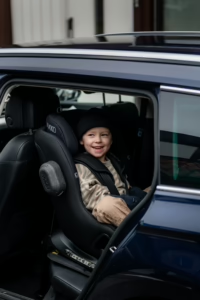
Marlo, who was almost three years old and travelling rear-facing, escaped with only minor injuries.
Jenny said:
“Had it not been for Marlo’s rear-facing seat, I was told by emergency services he likely wouldn’t be here now. I will be forever grateful I did my research because I’m sure his seat saved his life, or at the very least prevented serious injury.
“Parents shouldn’t have to carry out extensive research themselves to understand what is safest for their child. Since the crash, I’ve become passionate about raising awareness of rear-facing travel, and if sharing our story helps save even one child’s life, it will be worth it.”
Learning from Sweden
Although the UK and Sweden share the same legal requirement for children to remain rear-facing until at least 15 months old and 76cm in height, rear-facing travel is significantly more common in Sweden.
Recent data suggests that only around 22% of UK children aged two to four travel rear-facing, compared with 83% in Sweden.**
Experts suggest this difference reflects how child passenger safety information is communicated, with Swedish parents more commonly advised on what is safest for their child rather than simply what is legally required.
Sweden is also home to the Swedish Plus Test, one of the world’s most demanding child car seat assessments. The test measures the forces exerted on a child’s neck in a severe frontal collision and, to date, only rear-facing seats have successfully met its requirements.***
A recent Folksam study examining child fatalities aged 0–6 in Sweden between 1992 and 2024 found that more than one-third of child traffic deaths may have been preventable through rear-facing travel. The research concluded that up to 48% of children aged 0–3 who died in collisions may have survived had they been travelling rear-facing.****
Expert Commentary
Dr Maria Klingegård, Traffic Safety Researcher at Folksam and co-author of the study, said:
“Children are not simply small adults. They require additional support. Rear-facing child restraints provide robust protection, support the head and torso together, and significantly reduce forces on the neck.
“Sweden has among the lowest child fatality rates in the world because most parents keep children rear-facing until four or five years of age, or even longer. Every parent has a responsibility to ensure their child travels as safely as possible.”
Dr Neale Kinnear, behavioural scientist, road safety expert and father of two, said:
“Even with a professional background in road safety, I found navigating child car seat advice overwhelming as a parent. Many families remain unaware of the benefits of extended rear-facing travel or assume earlier forward-facing travel is the international norm.
“Parents need access to clear, consistent and evidence-based information to make informed decisions. Rear-facing travel is one practical step that can help improve child safety on our roads.”
Dr Anna Carlsson, Project Manager and Researcher at Chalmers Industriteknik, said:
“Sweden’s strong safety culture has helped achieve a 92% reduction in child passenger fatalities since the mid-1980s, reaching zero fatalities among child passengers aged 0–14 in 2021. Rear-facing child restraints have played a crucial role in that success.”
Dr Sarah O’Toole, psychologist specialising in child road safety and injury at the University of Central London, said:
“Improving child passenger safety requires more than legislation. Families need clear, consistent and evidence-informed guidance throughout the parenting journey.
“International evidence indicates that extended rear-facing travel can provide important additional protection for young children, yet awareness remains relatively low in the UK. Families should be supported with practical, accessible information that helps them make informed choices.”
Jayne Caul, Managing Director of Axkid UK, said:
“As both a parent and someone who has advocated for rear-facing travel for more than two decades, I understand the importance of helping families access clear information and make informed choices.
“Sweden has led the way in child passenger safety through evidence, collaboration and long-term commitment. The UK has an opportunity to learn from that success and consider how those lessons can help shape the future of child road safety.”
For more information and to support the campaign, visit the Rear Face for Safety campaign sign-up page.