Europe reveals itself most clearly through corridors rather than capitals. When cities are experienced in sequence, their differences soften into rhythm. Streets widen or compress. Stone gives way to glass, then returns again. Architecture does not announce meaning; it absorbs use. What feels monumental at first gradually becomes familiar, shaping movement more than memory.
Berlin, Paris, and London are often treated as cultural endpoints. Moving between them reframes that idea. These cities behave less like destinations and more like reference points — places you pass through repeatedly, learning their logic through habit rather than explanation.
Berlin and the Weight of Reuse
Berlin rarely hides its layers. New structures rise beside older ones without smoothing the seam. Space feels practical, even when symbolic.
In Berlin, architecture carries evidence of reuse. Buildings shift function. Public space adapts. Nothing feels sealed off from the present moment.
The city feels assembled rather than preserved.
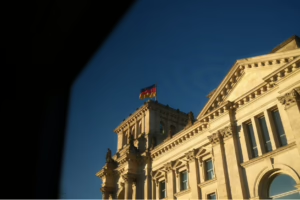
The Reichstag as Orientation
The Reichstag is often discussed for what it represents, yet on the ground it functions as orientation. People move around it daily. Paths cross its perimeter without pause.
Glass and stone coexist without ceremony. The structure feels active rather than symbolic, part of the city’s circulation rather than an endpoint.
Meaning settles into routine.
Leaving Without Disruption
Travel west does not fracture this tone. Taking the Berlin to Amsterdam train stretches continuity across borders. Movement feels smooth, contained, and expected.
Conversation stays low. Landscapes flatten and change gradually. Arrival does not feel announced.
Distance dissolves quietly.
Amsterdam and the Ease of Circulation
In Amsterdam, movement feels negotiated rather than directed. Canals curve gently, slowing orientation without stopping it. Streets remain narrow but readable, encouraging circulation over pause. The city doesn’t ask for attention through scale or monumentality; it works through balance. Bicycles, trams, and pedestrians share space with little ceremony, and water acts as both boundary and guide. Over time, Amsterdam feels less like a place you arrive at and more like one you keep moving within, its rhythm defined by flow rather than destination.
Paris and Accumulated Form
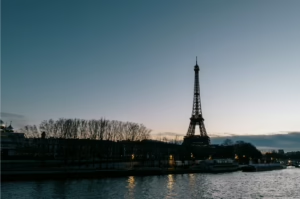
Paris gathers rather than adapts. Scale increases. Symmetry asserts itself. Streets guide attention through repetition.
In Paris, architecture layers visibly. Buildings face outward. Public space feels designed to be seen as much as used.
The city’s density presses closer, shaping movement through form.
The Louvre as Reference, Not Destination
The Louvre Museum rarely remains a destination for long. You pass it repeatedly. Routes bend toward it, then away again.
Over time, scale softens. The building becomes positional — something that helps you locate yourself rather than something you seek out.
Grandeur turns into familiarity.
Crossing Without Resetting
Moving onward does not require mental adjustment. Choosing to fly Paris to London compresses geography without flattening experience. The shift registers later, through posture rather than place.
Arrival feels absorbed rather than dramatic. Pace changes subtly.
Continuity holds.
London and History in Use
London reveals its past sideways. You encounter it while doing something else — waiting, crossing, walking with purpose.
In London, architecture remains active. Old structures change function without losing presence. Streets hold memory without performing it.
History feels worn-in rather than displayed.
The Tower as Background Structure
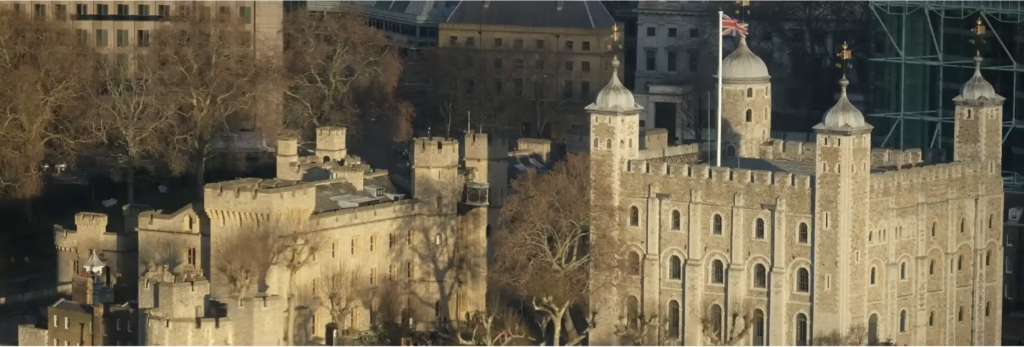
The Tower of London carries weight, yet daily life flows around it easily. Traffic passes. People cross nearby routes without pause.
The setting feels important without asking to be treated as exceptional. The building frames space more than it commands it.
Scale becomes background.
A Corridor, Not a Comparison
What links Berlin, Paris, and London is not style or era, but use. Each city has learned how to keep architecture active rather than distant.
Movement between them reinforces this. Travel does not reset attention. It extends it.
The corridor remains legible through repetition.
Learning Cities by Passing Through
Understanding these places does not come from stopping at landmarks. It comes from passing them often enough that they stop demanding attention.
You learn where pace changes. Where space tightens. Where buildings begin to guide movement instead of interrupt it.
The lesson arrives quietly.
What Remains After Movement Ends
Later, what stays with you is not a catalogue of structures, but a sense of orientation — how cities held you, directed you, released you again.
Berlin’s adaptability, Paris’s accumulation, and London’s continuity remain distinct, yet connected. They do not resolve into contrast.
They persist as a corridor of use and habit — steady, layered, and still unfolding long after you have moved on.